
I’ve recently discovered a problem I had, and, after some soul searching for a viable solution, found myself digging back into technology that I haven’t used in cough 25 years. It’s stationery-related (perhaps one would even say Stationery Adjacent), but first, a little background.
I’ve been rebuilding my music studio lately - or, if I’m completely honest, I’ve been reorganizing the pile of toys that got dumped in a space I’ve called my studio when I moved into this house. I never organized in a way that creates a good workflow for creativity, and I’ve been here for almost 5 years. My reorganization has been in a typical Twyford way of throwing lots of money at the problem.
Recent additions to the studio include a new Mac to run everything, new synthesizers, a new stand, a new slave mixer (I ran out of ports), a Theremin (you may have to Google that one!), and a fancy new music stand. Oh, and a new bass guitar, guitar stand, and bass amplifier to round out the spend. Just don’t ask why I need these new toys. It’s safer that way.
I’ve also purchased some music software - several VSTs, or virtual synthesizers, and a couple of online services, including one to download sheet music.
Who downloads sheet music in 2026?
I do. Apparently. When I was much younger, I used to enjoy playing a song over and over while I played along, trying to figure out the right notes by ear. I don’t seem to have that much passion, or to be honest, time, anymore, and playing along to sheet music seems so much more rewarding and efficient.
However, I’m not in love with online sheet music software - taking your hands off a keyboard to scroll up and down to change sheets ruins the flow. Instead, I find myself printing out sheet music and using that on a music stand. Maybe I’m just getting old, or it was the way I was taught, but it works best for me to follow along.
Some simple songs (with a piano layout) are a couple of pages long (and great for a paperclip). Other, more detailed, scores can be tens of pages - even over 100. A great use for a binder clip, perhaps.
But all of these piles of paper add up quickly. And, more importantly, make a disorganized mess on my studio desk, which I’ve just spent a small fortune trying to organize. What to do? Ringed binders? A waste for just a couple of sheets of paper, and it can quickly get disorganized when one puts too many disparate song sheets in one. Report covers? Expensive and a pain to get sheets in and out of.
I recalled an office I worked in having a comb-filling system for reports back in the nineties, before email and file sharing were a thing. I’m embarrassed to say I didn’t use it much, as there tended to be gendered roles and making booklets fell largely to the secretaries. Sounds terrible now, but not something one gave much thought to back in the day.
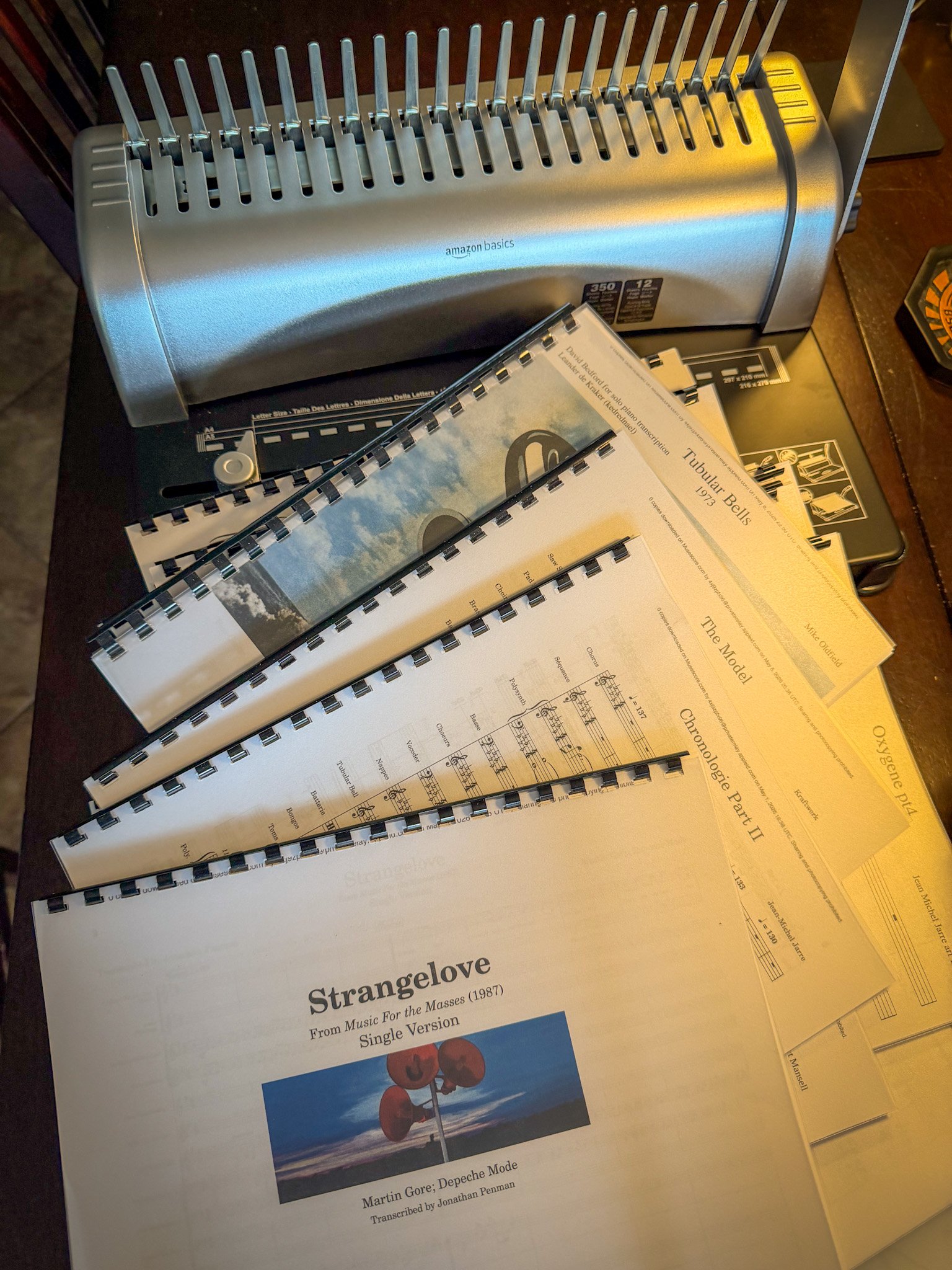
Some digging around on Amazon showed me that these tools were still being made. An inexpensive Amazon Basics comb filer was less than $100 shipped. Combs came in boxes of 100 and cost just a few pennies each. Clear plastic report covers are also inexpensive when purchased in bulk. I took the gamble and purchased it, hoping for a solution to the growing mess of disorganized paper on my desk.
I’d forgotten how big and heavy these machines were until this one showed up. Even as large as it is, it is still a relatively light-duty machine, and I have to be careful not to feed too many pieces of paper into the hole-punch side at once.
But the results are spectacular. Better than I could have imagined. The fit of all of the pages is on point. Each song gets its own comb file, and the ability to organize these booklets on a bookshelf keeps all of the piles of paper well organized.
I’m impressed. Sure, I could have spent hours figuring out and trying different apps to get one to advance properly, and likely would have had to incorporate another piece of technology, such as an iPad. But I’m old-school and prefer the paper. This old-school approach is working well for this old-school guy.
Technology is great, but sometimes the classics can't be beat.