
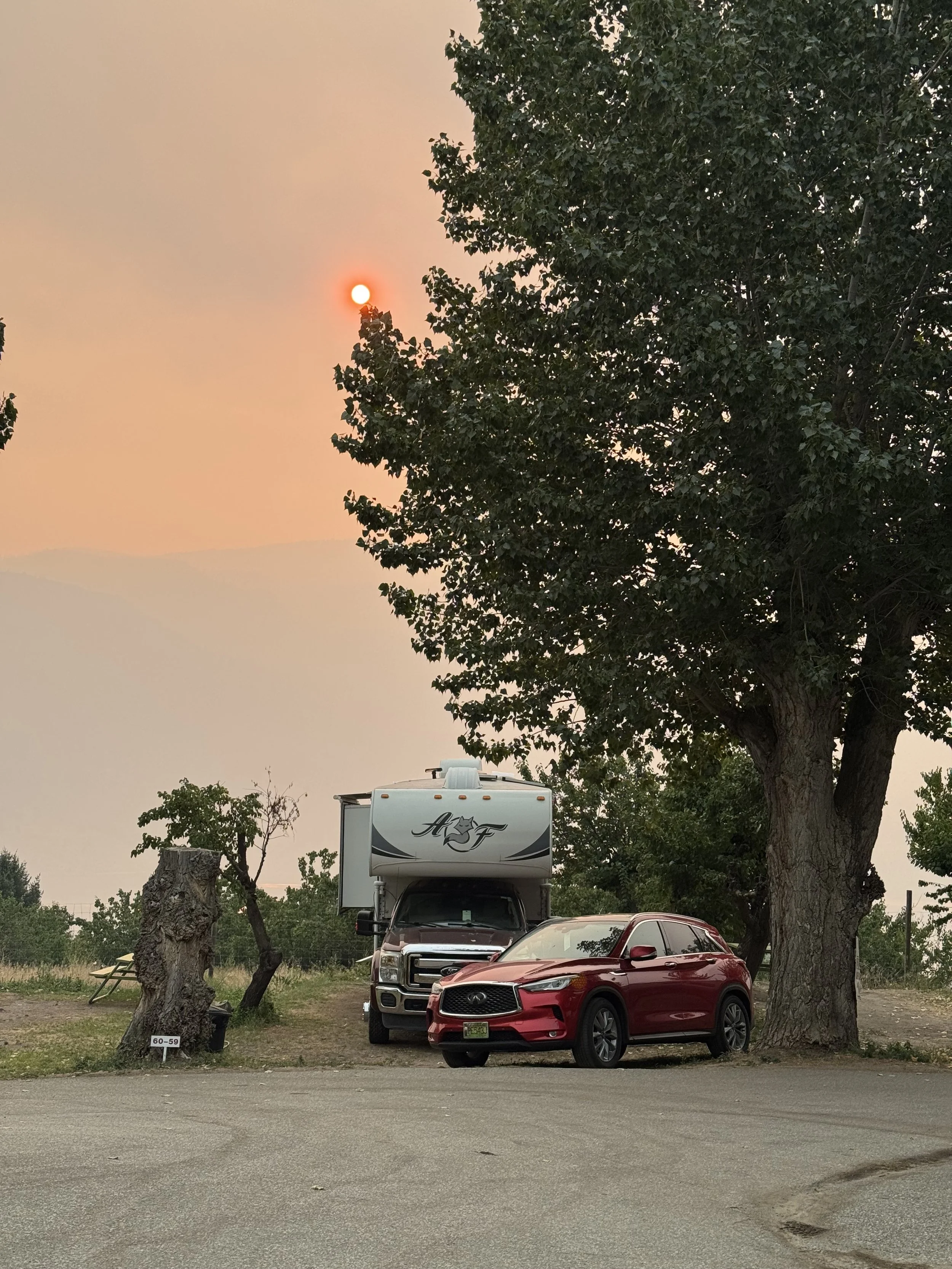
We left our intrepid adventurer (me) the morning after the Bald Range Fire, as it’s come to be known, ripped through the District of Summerland, causing the mass evacuation of the entire community- some 12,000 people- and the additional evacuation of 8,000 Peachland residents, our closest neighbour to the north. We had established ourselves at a small campsite on the hill above Skaha Lake in Kaleden, some 10 minutes south of Penticton, where the majority of the evacuees had gone. Unable to get support due to the volume of evacuees, we paid for the campsite out of pocket to get power and quiet so we could settle Coco, our Lhasa Apso, who had been stressed all night.
We had watched the flames on the hill above our house on our home cameras until the power went out at about 2:45 am, and had assumed we had lost the house to the fire. There was an odd sense of peace, as there was little we could do. There was little on-the-ground information available - the authorities were still fighting the fire. Pictures and videos of the devastation began to appear on social media, and with staggered evacuations as more and more of the community burned, the scope of the damage had increased. Areas I know were destroyed, which didn’t give me much hope for our house. Getting set up in a safe new place, getting groceries and other necessities, and wondering about our next steps were the only things on my mind.
Relief:
Late in the morning, we got a message from a neighbour that some in our area had sheltered in place and stayed home. And the report was that our neighbourhood had somehow survived. The neighbour who lives behind our house, a former wildfire jumper, sent me a picture of the back of our house. It was still standing, but that didn’t mean there wasn’t damage to the front of the home. But it was something positive - especially as we had to evacuate so quickly that we had left much of our belongings behind.
We felt relief, yet also increased nervousness. We heard reports that the fire was still out of control (and a few weeks later and this is still true) and that some significant structures near our home were still burning.
In a way, we were now nervous again for the future of the house. We had assumed we had lost it the night before, and now we had to wait, wonder, and hope. Strangely, it increased our sense of worry again. Lost is lost, and you move on. We were now on pins and needles again.
Frustration:
BC has had a long history of wildfires. While I don’t want to criticize anyone, especially as many of the emergency support services staff are volunteers, I do feel that official support and communication were lacking, to say the least. Perhaps this is because of modern sensitivities and not wanting to offend anyone, but it was very frustrating.
The BC government offered support and hotel placement for evacuees. We were self-set up, paying out of pocket for the campsite, and not near the support centre. Reports of 4- to 12-hour wait times for support were coming in on social media. We were encouraged to register online for information and support. That was a complete disaster as we never got a response.
The BC government’s website seems to push people to claim off their own insurance. I looked at my policy, including my claims-free discount, and calculated the amount we would need to exceed to make a claim worthwhile. I would lose that significant discount for the next 5 years and would also be locked into my current insurer, as changing insurers during the 5-year post-claim period is very expensive and difficult.
Official communication was sketchy. RDOS, the local regional district, began to set up a daily update on YouTube, but facts were hard to come by at first. I watched the first presentation, and the speaker started by correcting the presenter with his correct job title. You know that government is involved when correct job titles are more important than the existence of the town! That said, the BC Wildfire Service has an amazing spokesperson, Erin, and they came prepared with facts about the fire’s growth, direction, and assets deployed for fighting the fire. Very solid.
The regional district and the local government tried to be helpful but, for much of the first week, were not. They kept us in the dark about properties lost and kept referring to a “process” that involved many agencies, but failed to define what that recovery and return process was. If I had been in a better frame of mind, this would have become a funny drinking game - take a shot for every time the mythical “process” was mentioned. It would have made time pass more quickly. The final straw for me was tuning in to the presentation for facts and being given a 5-minute diatribe about a wildfire conference the presenter was going to attend in November. Read the room, Sir. Nobody cares. I switched to the new drop of Ted Lasso on my laptop, which was the enjoyable relief I needed.
I’m not a huge fan of social media in general, but when I moved to this community, I realized there was an active online community centred on Facebook groups. I joined a few and have used them to find recommended resources, such as plumbers, etc., that I needed. These groups were absolutely invaluable in getting information and support. People were kind, supportive and helpful. One local councillor began posting detailed information about what they had heard, and information they had access to, that became one of the best sources of information there was - especially as there was no reference to a mythical “process”. Someone gets my vote in the next election for sure!
Support:
The councillor I mentioned above was very helpful in getting us set up with government support. I had registered for support online, but got no response - my claim was in limbo. But I was hearing about the government-authorized supports. Why should some people get that while others are paying out of pocket? I reached out to the councillor and suggested they post about the support services available to those affected. Information that was missing and confusing, and, unless you were sleeping on a cot or parked at the emergency services centre, was unavailable online. To my surprise, they called me with some advice and a phone number to call, and within a few hours I had support in place - incidentals, emergency food allowances and an allowance for housing. This helped cover our costs, as being evacuated is expensive - from clothes to all new groceries and essentials, to a daily camp rental cost that quickly added up. Not to mention, we were able to support the child, who had been vacationing with friends in the Vancouver area and had to stay with family there while we were in the camper.
Our house:
Power at home came back on after a couple of days, and our cameras came up. While we only had a limited view of the outside of the house, there wasn’t any obvious damage, but we could see the sparks and ashes coming down at night from the local fire.
A fireman had moved all of my outdoor furniture to the middle of my driveway, and I could see it was covered in ash. I found out that they had also raked my grass to ensure there were no dry cuttings that could ignite.
As the firemen worked on the fire at a local facility, the number of sparks decreased over time. This facility is still burning a couple of weeks later!
A week after the evacuation, small communities in our district - areas unaffected by the fire - were allowed to return. And every few days, another small community went home. These were the areas on the other side of town from where I live.
Nine days after the evacuation, we were permitted a three-hour window to return home. This allowed us to see that the house, apart from ash and smoke, was in good shape. We also got a chance to empty the fridge of rotting food, as we had been without power for some time. The groceries in the freezers had refrozen and were a problem for another day. We also had time to plan what we would need. Work files that were left on my desk, journals, clothes, and other essential items were carefully transported to the camper. Luckily, we left with both my truck/camper combo and my wife’s car, so we had transport. My Jeep, Harley, and Side-by-Side were left behind to chance on the driveway! They appeared undamaged, but covered in ash, when we visited the house.
At this point, we were into week two of the evacuation and didn’t want to leave. However, our permit came with conditions, and we would have been subject to arrest if we didn’t check out of the process. We left, sadly, to return to the camper for an unknown period of time, as specified by the local authorities. I felt we could have stayed at home.
After the visit, I just wanted to go home - now that I knew we had one to return to.